
As we begin 2026, what keywords might shape conversations about teaching in the year ahead?...
As AI tools continue to evolve at a rapid pace, it is easy to feel pressure to keep up with every new model. In practice, however, what matters is not the number of tools we use, but how we use them. The real value lies in our thinking and professional judgment.
Recently, Harvard Business Review reported on a University of California, Berkeley study examining the use of an AI tool in a U.S. technology company. The study found that while AI improved efficiency, it did not reduce work intensity. Instead, employees often worked longer, moved at a faster pace, and took on a broader range of tasks. This challenges the common belief that AI will automatically replace repetitive work and lighten human workloads.

Image from Harvard Business Review
So why doesn’t greater efficiency necessarily lead to a lighter workload?
To explain this pattern, LSE professor Luis Garicano has described it as a “Jevons paradox for work effort”: When AI takes over repetitive tasks but does not necessarily reduce overall workload, humans may increasingly take on more complex and cognitively demanding tasks, potentially increasing fatigue and stress.
As highlighted in a recent report by Educate Ventures Research, Berkeley-based researchers describe this phenomenon as “cognitive debt,” referring to a potential reduction in deep cognitive engagement when AI systems take over cognitively demanding tasks. As AI accelerates work beyond what humans can effectively monitor, it may limit opportunities for reflection and deep thinking.
-3.png?width=508&height=598&name=1280X1280%20(1)-3.png)
Image from Harvard Business Review
This concern does not emerge in isolation. A growing body of research suggests that AI is being integrated into an already shifting cognitive environment—one shaped by shorter attention spans, increased task fragmentation, and changing patterns of engagement:
University of California, Irvine (Gloria Mark)
Average attention on a single task has declined from approximately 2.5 minutes in 2004 to around 47 seconds today.
King’s College London (2022 survey)
-
49% of adults report that their attention spans have shortened
-
47% feel that “deep thinking” has become less common
Anthropic (Claude usage analysis)
Many students appear to use AI tools in a transactional way—primarily to generate answers rather than engage in dialogue, reasoning, or reflection. At the same time, the analysis found that nearly half of teachers who used AI for grading fully delegated the task to the tool, despite recognising its limitations.
Mithu Storoni (neuroscientist)
Over-reliance on AI for cognitive effort may weaken core mental capacities such as synthesis, contextual judgment, and curiosity.
Demis Hassabis (Google DeepMind)
As AI increasingly takes over tasks such as coding, some of the most important human capabilities may shift toward taste, creativity, and judgment—skills that depend on sustained cognitive engagement.
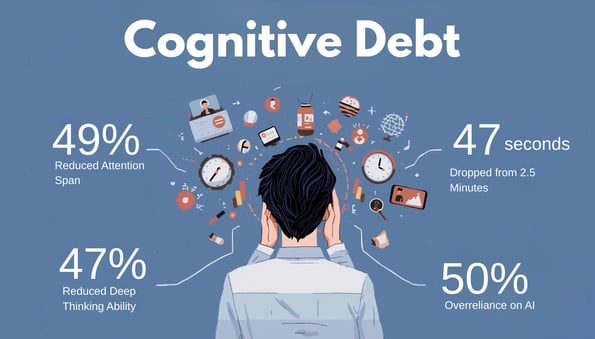
Image created through human–AI collaboration
.png?width=401&height=398&name=1280X1280%20(2).png)
Image from Educate Ventures Research
What, then, might these trends mean for university teaching and faculty development?
1. Understand cognitive load and develop AI literacy
Greater efficiency does not necessarily mean a lighter burden. If people use AI tools without understanding how to manage their effects, burnout becomes more likely. In both teaching and academic work, it is important to create patterns of use that alternate between AI-assisted tasks and independent thinking.
2. Preserve space for deep thinking
In both work and learning, the goal should not be speed alone, but quality, understanding, and reflection. For every AI-assisted task, we should ask: What cognitive work is the learner actually doing? It is not enough to evaluate the output; we must also consider the thinking behind it.
3. Maintain independent judgment
Before adopting any tool, educators should consider what data it collects, what safeguards are in place, and what happens if the tool is no longer available. Effective use of AI requires not only convenience but also critical judgment.
Ultimately, the issue in education is not simply whether AI is changing the way we think; in many ways, it already has. The more important question is whether we can intentionally shape how AI is integrated into teaching and learning around the forms of thinking we value most.
References:
Bedard, J., Kropp, M., Hsu, M., Karaman, O. T., Hawes, J., & Kellerman, G. R. (2026, March 5). When using AI leads to “Brain Fry”. Harvard Business Review. https://hbr.org/2026/03/when-using-ai-leads-to-brain-fry
Luckin, R., & EVR Team. (2026, February). The Skinny on AI for Education (Issue 25). Educate Ventures Research. https://www.educateventures.com/the-skinny-25-february-2026
Key Updates about CTL
Registration Now Open | Professional Development Program on Artificial Intelligence Literacy in the Digital-Intelligence Era
The program centers on the integration of AI-driven creativity and pedagogy, offering innovative teaching methodologies and insights into cutting-edge technological developments. The curriculum covers AI-empowered teaching practices, case studies in instructional innovation, and emerging frontiers in AI technologies. Instruction is delivered by senior faculty members of Peking University, supported by doctoral-level teaching and research teams.
-
Dates: April 23–26, 2026
-
Location: Yanyuan Campus, Peking University (Beijing)
-
Format: In-person instruction + visits and study tours + seminars and discussions
-
Language: Chinese
For more information, please click here.
2026–27 CTL Faculty Fellowship Program: Call for Applications
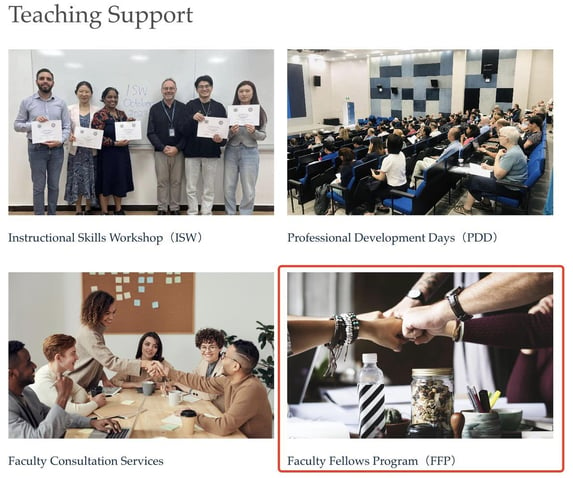
The CTL Faculty Fellowship Program(FFP) aims to support the growth, collaboration, and sharing of effective teaching practices among WKU faculty. Through this program, faculty fellows work with CTL to develop workshops and learning resources that support instructors across the university. Faculty members who are interested in contributing to teaching and professional development across campus are encouraged to apply.
Application Deadline: March 31
Application Form: Apply here
For more information, please visit the program webpage or email.
Instructional Skills Workshop
We are pleased to announce the upcoming Instructional Skills Workshop (ISW) — a signature faculty development program designed to strengthen teaching practices through experiential learning.
🗓️ Upcoming Sessions
- Session #26: May 16-17 & May 30-31.
Participants will explore core teaching and learning concepts, reflect on current practices, experiment with new instructional strategies, and engage in supportive environments.
We look forward to discussing this excellent opportunity to increase student engagement with interested faculty and staff of WKU. Please note that participation is limited to five individuals, and all four days of the workshop are required.
Scan the OR code to register >>

Author: Yan (Tanya) Tang
Chief Editor: Yirui (Sandy) Jiang